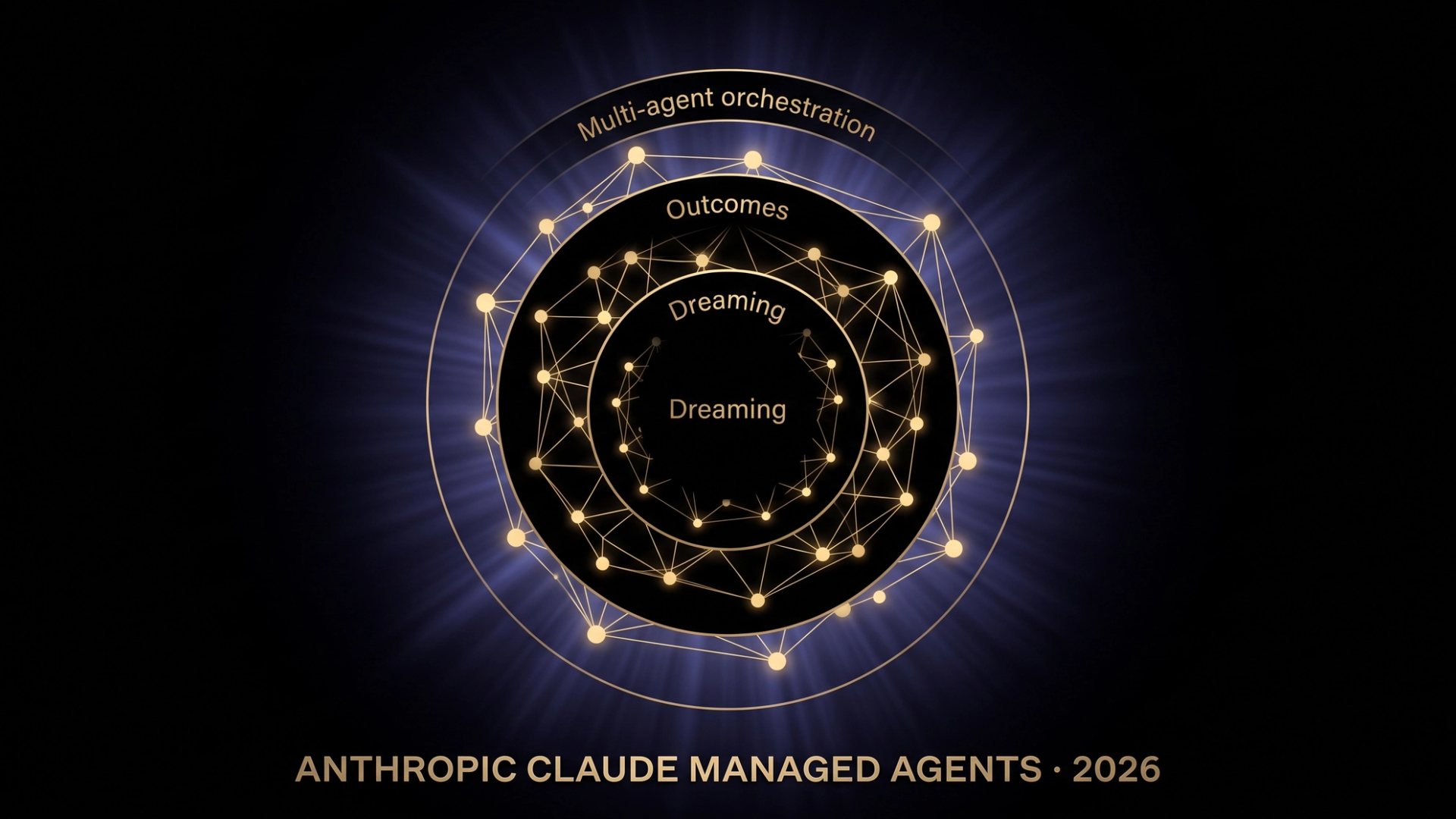
Current status as of July 1, 2026: Claude Managed Agents has moved Anthropic from "model provider" toward "agent runtime provider." The April 2026 public beta gave developers a managed harness for running Claude as an autonomous agent. The May 2026 updates added three important pieces: Dreaming, a research-preview memory process; Outcomes, a public-beta way to define and grade success; and multi-agent orchestration, a public-beta pattern where a lead agent delegates work to specialist sub-agents. The result is a clearer enterprise pitch: stop wiring together your own agent loop, memory store, evaluation layer, credential handling, and sandbox. Let Claude run the loop. That is powerful, but it also creates a new procurement question: how much of your operating workflow should sit inside a hosted agent platform?
Quick facts
The simplest definition: Claude Managed Agents is Anthropic's managed execution environment for autonomous Claude workflows. Instead of building your own loop around the model, you configure an agent, give it tools and credentials, run sessions, and track events through Anthropic's managed harness.
What "Managed Agents" actually means
An AI chatbot answers a prompt. An agent runs a process. That process may involve reading files, calling tools, browsing, writing code, checking results, retrying failed steps, and deciding when enough work has been completed. Before managed agent platforms, teams typically built that process themselves.
Anthropic's Claude Managed Agents overview describes the product as a managed harness and infrastructure layer for running Claude as an autonomous agent. It handles the loop that many developers previously assembled from separate parts: prompts, tool execution, runtime, sandbox, streaming events, caching, compaction, and session state.
The engineering idea is explained in Anthropic's post Scaling Managed Agents: Decoupling the brain from the hands. The "brain" is the model reasoning about what to do. The "hands" are the tools, environments, sandboxes, and external systems that let the agent act. Managed Agents tries to separate those layers so the model can use new tools and execution environments without every customer rebuilding the same architecture.
That makes the product more than an API wrapper. It is closer to an operating layer for AI labor. A company can define an agent for a recurring job, attach approved tools, use vault-backed credentials, and inspect what happened in each session.
The tradeoff is control. When a platform manages the loop, it also shapes how memory, evaluation, orchestration, credentials, and execution are represented. That can reduce engineering burden, but it can also make the platform a bigger part of enterprise architecture.
Dreaming: agents that learn from their own mistakes
Dreaming is the most attention-grabbing word in the May update, but the practical meaning is less mystical and more operational. According to Anthropic's API release notes, Dreams for Claude Managed Agents are a research preview. A dream reads an existing memory store alongside past session transcripts and produces a reorganized output memory store, merging duplicates, replacing stale entries, and surfacing new insights.
In normal language: the agent can review what happened before and clean up what it knows.
That matters because agent memory can get messy. A production agent may run hundreds or thousands of sessions. It may learn exceptions, customer preferences, tool quirks, recurring failure modes, and undocumented internal processes. If all of that memory accumulates without curation, it becomes noisy. If the memory is too aggressive, it can preserve outdated or incorrect assumptions.
Dreaming is Anthropic's answer to that problem. Instead of memory being only a write-once accumulation of facts, the system can periodically reorganize memory from past work. VentureBeat described the feature as an attempt to let agents learn from their own mistakes, while The New Stack framed it as part of Anthropic's move to make managed agents more self-improving.
The enterprise value is obvious for repeat workflows. A support agent could learn which troubleshooting paths fail. A finance-operations agent could learn which reports need manual reconciliation. A developer agent could learn which deployment logs matter first. But the governance risk is also obvious: memory must be inspectable, bounded, and correctable. A self-curating memory store is useful only if administrators can understand and constrain it.
Outcomes: defining success and grading against it
Outcomes is the least flashy feature and possibly the most important one. Enterprise teams do not just need agents to act. They need agents to know what success means.
In many early agent demos, the system stops when it appears to have completed the task. That is not enough for real deployment. A customer-service refund workflow may require policy compliance, tone constraints, data updates, customer notification, and audit evidence. A finance workflow may require a reconciled output, exception list, and reviewer note. A development workflow may require passing tests, updated documentation, and no secret leakage.
Outcomes lets teams define success criteria that can be graded. Anthropic's May 2026 API release notes list multi-agent sessions and Outcomes as public beta under the managed-agents beta header. Coverage from VentureBeat and The New Stack describes Outcomes as a way to set specific rubrics and use an evaluation step, including grader-agent behavior, to check whether work met the intended goal.
This turns agent deployment from "prompt and hope" into "task, rubric, evidence." The agent still can be wrong. The grader can still miss issues. But the structure is closer to how companies already manage human work: define the job, define acceptable output, inspect against a standard, and escalate exceptions.
The procurement implication is direct: before buying an agent platform, ask how it defines success, how it scores failure, and how humans can inspect both.
Multi-agent orchestration: lead agent + sub-agents
Multi-agent orchestration addresses a practical bottleneck: one agent cannot hold every subtask, file, tool, and reasoning branch cleanly forever. Complex work often needs parallel investigation.
The May update introduced public-beta support for multi-agent sessions. In the common pattern, a lead agent breaks a job into parts and delegates each part to specialist sub-agents. One sub-agent might search logs. Another might inspect metrics. Another might review support tickets. Another might draft the incident summary. The lead agent coordinates, compares findings, and decides the final answer.
SD Times summarized the pattern as a lead agent delegating pieces of complex work to specialists with their own prompts, models, and tools. That is close to how human teams operate. A manager does not personally read every log line, customer email, and deployment diff. The manager assigns work, receives summaries, checks conflicts, and makes a decision.
This is especially relevant for tasks with several independent evidence streams:
- Incident response across deploy logs, observability, support reports, and code changes.
- Financial close across invoices, bank exports, ERP entries, and exception notes.
- Legal research across contract clauses, policy libraries, and jurisdictional updates.
- Customer service operations across tickets, CRM records, product telemetry, and refund rules.
- Security review across source code, dependency alerts, runtime logs, and policy controls.
Multi-agent design is not automatically better. It can multiply cost, create contradictory findings, and make debugging harder. But for broad tasks, it is often more realistic than forcing a single agent to think and act through every branch.
The real deployment: Netflix, customer service, finance ops
The brief flags Netflix as an example of multi-agent orchestration being used to analyze logs. Treat that as a directional deployment signal unless your publication pipeline has a direct primary-source quote ready to attach. The broader pattern is already clear from the technology itself: log analysis is one of the cleanest multi-agent use cases because different sub-agents can inspect separate systems and return structured evidence.
Customer service is another natural fit. A lead agent can interpret the customer issue, while sub-agents check order status, policy rules, prior tickets, product documentation, and refund eligibility. Outcomes can define what a correct resolution looks like: accurate policy application, no unauthorized concession, clear customer message, and escalation when confidence is low.
Finance operations may be even more valuable. Reconciliation work is repetitive, evidence-heavy, and exception-driven. A managed agent can compare reports, flag mismatches, draft variance explanations, and prepare review packets. But this is also where governance matters most. The agent should not be allowed to move money, approve invoices, or change accounting records without human controls.
The same pattern applies in IT. An agent can triage alerts, examine logs, identify likely root causes, and draft remediation steps. Multi-agent orchestration makes sense when one sub-agent checks deployment history, another checks infrastructure metrics, and another reviews known incidents.
The winning enterprise deployments will not be "replace a department with agents." They will be narrower: automate the evidence collection, draft the first pass, grade the output, and route exceptions to humans.
What this changes for enterprise IT procurement
Claude Managed Agents changes the procurement conversation because it bundles pieces that used to be separate buying decisions. Before, a company might choose a model provider, orchestration framework, vector database, credential store, sandbox provider, evaluation tool, and observability layer. Anthropic is now offering more of that stack in one managed platform.
That can be attractive for teams that are tired of stitching together fragile agent prototypes. Hosted compute reduces setup work. OAuth integration and credential vaults make tool access cleaner. MCP standardization makes it easier to connect external systems. Webhooks and session events create operational hooks. Built-in evaluation structures can shorten the path from experiment to production pilot.
But bundling also increases dependency. VentureBeat's analysis argues that Anthropic is moving into memory, evaluations, and orchestration in ways that may compete with standalone tools and increase platform lock-in. That does not make the product bad. It means procurement should be explicit about what is being outsourced.
Ask these questions before deployment:
- Which data enters the managed agent environment?
- Which tools can the agent call, and under what identity?
- Can credentials be rotated, scoped, and revoked cleanly?
- Are memory stores inspectable and deletable?
- Are Outcomes rubrics versioned and auditable?
- Can sensitive workloads use self-hosted sandboxes or private network MCP tunnels?
- What happens if the company later changes model providers?
The right buyer is a team that wants a managed path to agentic workflows and accepts the platform tradeoff. The wrong buyer is a regulated team that cannot explain where data, memory, tools, and evaluations live.
Cloud agent vs on-device agent: the privacy math
Claude Managed Agents is built for work that benefits from hosted infrastructure. That includes browsing, code execution, managed sandboxes, tool calls, credential flows, memory, evaluation, and multi-step orchestration. For many enterprise workflows, cloud execution is the point. The agent needs access to systems that already live in the cloud.
But not every AI task belongs there. Some work is sensitive because of the content itself, not because of the tool. Executive conversations, legal strategy, board materials, M&A planning, personnel decisions, and private client data may require a different architecture.
The privacy math is simple:
The answer is not "cloud bad, local good." The answer is workload placement. Cloud agents are excellent when integration, compute, and orchestration matter. On-device AI matters when the user cannot accept any third-party processing path.
Action plan: when to deploy Claude Managed Agents
Deploy Claude Managed Agents when the workflow is repeatable, evidence-heavy, tool-dependent, and measurable. Do not start with vague goals like "make the team more productive." Start with a job that has inputs, outputs, rules, and an escalation path.
Step 1: choose one workflow with real operational pain. Good candidates include incident triage, support summarization, contract intake, sales-account research, finance reconciliation, and internal knowledge-base maintenance.
Step 2: write the Outcome before writing the prompt. Define what a successful answer must include, what errors are unacceptable, what evidence must be cited, and when the agent must escalate.
Step 3: map tools and credentials. Give the agent the minimum access needed. Use scoped credentials, vaults, and short-lived authorization where possible.
Step 4: decide what memory may store. Separate durable process learning from sensitive customer or employee data. Memory is valuable only when it is bounded.
Step 5: run a side-by-side pilot. Let the agent draft, collect evidence, and grade its own output, but keep human approval in the loop until failure modes are known.
Step 6: track cost by task, not by token alone. Multi-agent orchestration can be expensive if every job fans out too broadly. Measure the cost of a completed useful outcome.
Step 7: decide what must never enter the platform. A strong agent policy is not only a list of allowed use cases. It is also a list of prohibited data classes and workflows.
If a workflow cannot be measured, cannot be audited, or cannot tolerate an agent mistake, do not automate it first. Use Claude Managed Agents where the benefit of orchestration is real and the risk can be bounded.
Sources checked
- Anthropic docs: Claude Managed Agents overview
- Anthropic engineering: Scaling Managed Agents: Decoupling the brain from the hands
- Anthropic docs: API release notes, May 2026 Managed Agents updates
- Anthropic news: New capabilities for building agents on the Anthropic API
- VentureBeat: Anthropic introduces "dreaming"
- VentureBeat: Anthropic wants to own your agent's memory, evals, and orchestration
- The New Stack: Anthropic will let its managed agents dream
- SD Times: New in Claude Managed Agents: dreaming, outcomes, multiagent orchestration
Related reading from VERTU Guides
- Best Smart Phone in USA: Executive Buyer's Guide
- Best Phone for Business and Personal Use
- Luxury Mobile Phones Buyer's Guide
- Luxury Foldable Phone AI Assistant Price Tiers
For a Different Kind of Audience
If your workflow is "summarize a customer email, draft a contract clause, route a support ticket," a Claude Managed Agent on Anthropic's hosted infrastructure is the right tool. If your workflow is "an executive conversation that cannot leave the room, a board memo that cannot be logged, or sensitive deal data that should never be aggregated to a third-party cloud - even a 'managed' one," a different kind of device exists: see luxury phones with on-device AI assistants for hardware that runs frontier-class models without any cloud handoff.