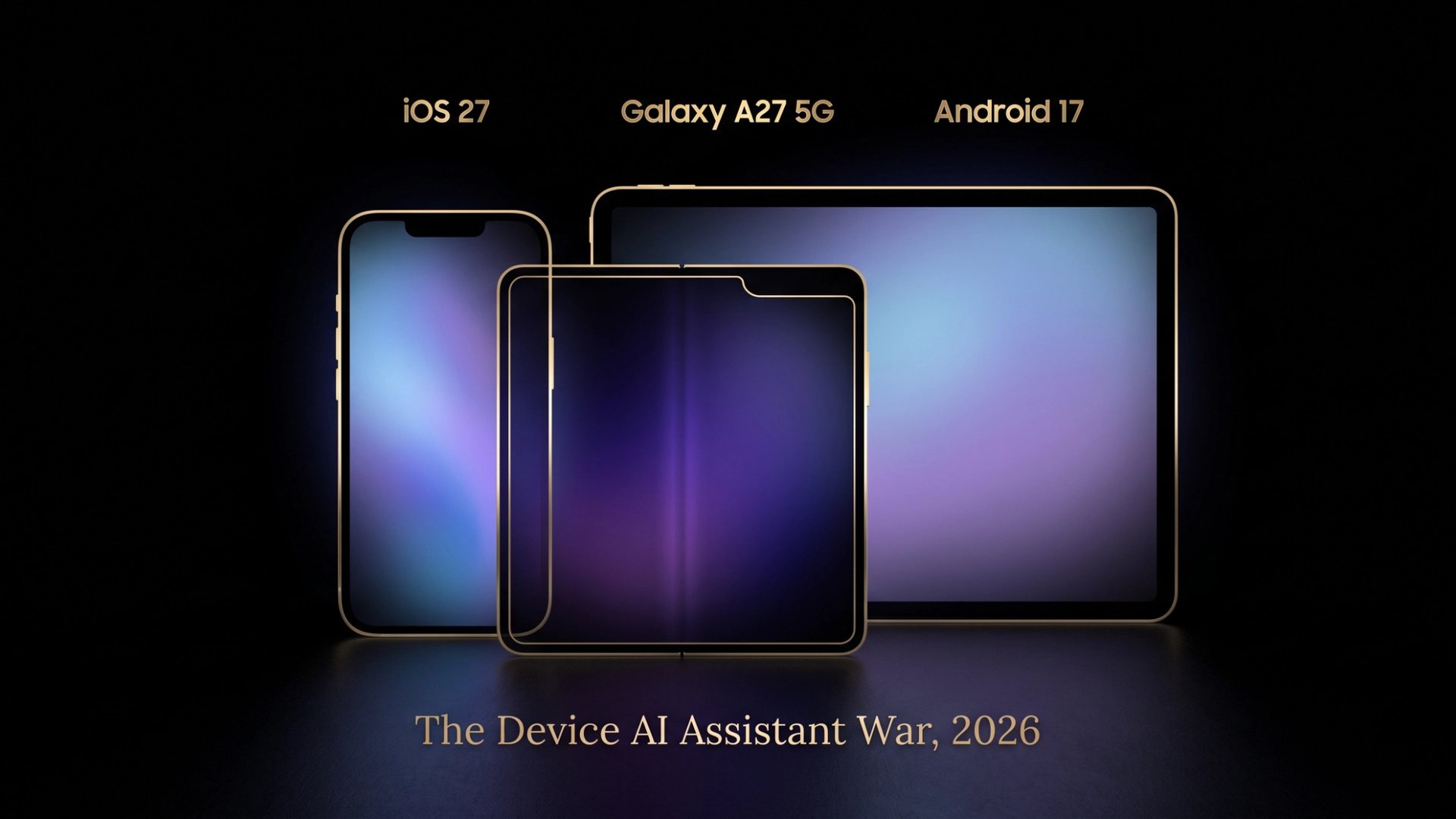
Current status as of July 1, 2026: the AI assistant fight has moved from apps into devices. Apple is rebuilding Siri AI and Apple Intelligence across iOS 27, iPadOS 27, macOS 27, and visionOS 27, with reporting pointing to Google Gemini as a key model partner. Samsung has announced the Galaxy A27 5G with Gemini, Perplexity, Circle to Search, and deeper assistant hooks. Google is pushing Gemini 3.5 Flash, Gemini app features, Android development support, and system-level AI experiences across its own ecosystem. The strategic pattern is clear: every major device maker wants to become the front door for daily AI use. The unresolved question is just as clear: when your phone becomes the AI shell, where does your data actually go?
Quick facts
The device AI assistant war is not simply about which chatbot gives the best answer. It is about who receives the prompt first. The company that controls the lock screen, keyboard, voice assistant, browser, camera, app shortcuts, and notification layer can make its AI assistant feel like part of the phone rather than a separate product.
The 2026 device-AI battlefield: who controls the front door
The first phase of consumer AI was destination-based. You opened ChatGPT, Gemini, Claude, Perplexity, or another app. The second phase is ambient. You ask from the phone, the browser, the keyboard, the inbox, the camera, or the operating system.
That shift favors device companies. Apple controls iOS and the premium iPhone base. Samsung controls the world's most visible Android hardware brand and can place AI features across Galaxy devices. Google controls Android, Search, Gemini, Chrome, Workspace, and the underlying model stack behind many assistant experiences.
The device layer has three advantages.
First, it owns the user's intent moment. If a user highlights text, takes a photo, receives a message, or opens a document, the device can offer AI help before the user thinks to open a standalone app.
Second, it owns context. A device can see screen state, app state, contacts, files, calendar events, location permissions, camera inputs, and notification patterns, depending on user settings and platform rules. That can make assistant responses more useful, but it also raises privacy stakes.
Third, it owns defaults. Most users do not change defaults unless the default fails. If the built-in assistant is good enough, it will capture a large share of casual AI prompts.
This is why Apple, Samsung, and Google are no longer competing only on hardware specs. They are competing to define the shell around AI work.
Apple: iOS 27 Siri AI routes to Gemini and maybe Claude
Apple's public story is Apple Intelligence plus a more capable Siri AI. In its newsroom announcement, Apple says new Siri AI features are available for developer testing across iOS 27, iPadOS 27, macOS 27, and visionOS 27, with a beta later in the year for supported devices and languages. The same page notes that Siri AI will not initially be available in China and has platform-specific limitations in the EU.
The more strategically important layer is model sourcing. MacRumors reported that Apple revealed a new Apple Intelligence architecture built around foundation models developed in collaboration with Google using technologies behind Gemini. Earlier MacRumors reporting also described iOS 27 support for third-party chatbot choices inside Apple Intelligence, including Claude and Gemini.
If that architecture plays out at scale, Apple does not need to win the model race alone. It can own the user experience while routing some intelligence through partner models and Apple's own privacy infrastructure. That is classic Apple platform strategy: control the interface, abstract the supplier, and make the feature feel native.
For users, the benefit is obvious. Siri could become more useful without requiring them to manage multiple standalone AI apps. For developers, it creates a new distribution channel. For Google, it could turn Gemini into invisible infrastructure across a massive Apple installed base.
The risk is also obvious. "Apple Intelligence" may sound local and private, but some features can involve server models, partner models, or cloud compute. The right privacy question is not "does Apple brand this as secure?" The right question is "which task is processed on-device, which task is routed to Apple's private compute, and which task touches a third-party model?"
Samsung: Galaxy A27 5G ships with Gemini + Perplexity
Samsung's Galaxy A27 5G shows that device AI is no longer only a flagship story. Samsung's global newsroom announced the Galaxy A27 5G on June 25, 2026, describing an A-series phone with a 6.7-inch Super AMOLED display and "Awesome Intelligence" features. Regional Samsung pages and press coverage point to support for Google Gemini, Perplexity, Circle to Search, and deeper assistant behavior.
The strategic point is not the A27's spec sheet alone. It is the price tier. When AI assistant access moves into mid-range phones, the market shifts from early adopters to mass distribution. A user buying a mainstream Galaxy device may receive multiple AI entry points by default: Circle to Search for visual search, Gemini for general assistant tasks, Perplexity for answer-style queries, and Samsung's own assistant hooks for device control.
Samsung's U.S. newsroom says the Galaxy A27 5G will be available in the U.S. on July 14, 2026, starting at $349.99. The global rollout begins earlier, with coverage citing July 3 for broader availability. Android Central and The Verge coverage also emphasize the same pattern: AI features are becoming normal even below ultra-premium phones.
This is Samsung's advantage. It does not have to own the foundation model to own the distribution surface. It can bundle, choose, and position assistants across Galaxy hardware. That gives Samsung leverage with AI providers and gives users a phone-level menu of AI services.
The downside is complexity. If a phone has Gemini, Perplexity, Bixby, Circle to Search, Samsung apps, Google apps, and third-party assistant extensions, the user may not always know which service is handling which request. Convenience improves. Transparency can get worse.
Google: Gemini goes system-level on Android 17
Google's position is structurally different because it owns both the model family and the Android ecosystem. At Google I/O 2026, Google announced Gemini 3.5 Flash, Gemini Omni, agentic Gemini app updates, Antigravity, Managed Agents in the Gemini API, and a broad set of AI product integrations. Its I/O 2026 announcement roundup describes Gemini 3.5 Flash as generally available through Google AI Studio, the Gemini API, Android Studio, and other developer surfaces.
The brief frames Gemini 3.5 Flash as embedded into Android 17 at a system level, with Pixel 11 emphasizing on-device capabilities. Treat that as the emerging platform direction: Google is making Gemini available not only as an app, but as an operating-system and developer layer. Even when specific Android 17 implementation details vary by region, device, and beta status, the direction is unmistakable.
Google's advantage is integration depth. Gemini can connect to Search, Gmail, Docs, Drive, Calendar, Chrome, Android Studio, Google Photos-style workflows, and device features. That means the assistant can move from "answer my question" to "help me act across my Google environment."
Google's risk is trust. The more context an assistant can use, the more users and regulators will ask how that context is stored, routed, retained, and monetized. A highly integrated assistant is more useful because it sees more. That same fact makes privacy architecture more important.
For Android users, the practical question is not whether Gemini is powerful. It is whether the assistant's convenience justifies the data path for each task.
The common pattern: all three depend on the cloud
Apple, Samsung, and Google all talk about device intelligence. But the most capable assistant workflows still often depend on cloud models, partner infrastructure, or hybrid routing. On-device AI is improving, but there are tradeoffs around model size, latency, battery, memory, and capability.
The common 2026 pattern looks like this:
This does not mean cloud AI is unsafe by default. It means "AI on your phone" and "AI processed only on your phone" are different claims. A phone can be the interface while the reasoning happens elsewhere.
For casual users, that may be acceptable. Asking an assistant to summarize a public web page or draft a dinner invitation does not carry the same sensitivity as discussing a legal strategy, a private medical appointment, an acquisition target, or a board decision.
The problem is that the interface feels the same in both cases. A user asks the phone a question. The phone answers. Under the surface, the data path may be completely different.
What the channel war means for users
The channel war will make AI easier to use and harder to understand. That is the paradox.
It will be easier because AI will appear at the moment of need. You will not need to open a separate app to translate a message, summarize a page, create a reminder, identify an object, draft a response, or search across documents. The assistant will sit near the action.
It will be harder because the assistant layer will be abstracted. A request may be handled by the device, by an operating-system model, by a partner model, by a cloud service, by an app extension, or by a combination. Brand names will blur. The user may see "Siri," "Galaxy AI," or "Gemini," while the actual processing path is more complex.
Users should therefore make decisions by workload:
- Use built-in assistants for low-risk convenience tasks.
- Use ecosystem assistants when the job depends on files, email, calendar, browser, or app context.
- Use specialist assistants when quality matters more than default placement.
- Use local or on-device options when the content should not leave the user's control.
- Turn off or restrict assistant access for apps and data categories that are not worth the convenience tradeoff.
The best assistant is not the one with the loudest launch event. It is the one whose data path matches the sensitivity of the task.
On-device AI: the alternative the three giants don't want
True on-device AI means the model runs on the hardware in the user's possession, and the task does not require a cloud handoff. That is not the same as a phone that can call a cloud assistant quickly.
On-device AI has limits. Smaller local models may be weaker than frontier cloud models. They may need careful optimization. They may not have live web access. They may be slower on complex tasks. But they offer a different privacy promise: the sensitive input does not have to be transmitted to a third-party service for processing.
This distinction matters most for high-stakes users. Executives, attorneys, family offices, security teams, diplomats, founders, board members, and high-profile individuals often care less about novelty and more about control. For them, the ability to process sensitive conversation, notes, and planning locally can be more valuable than having the smartest cloud model for every task.
The three platform giants have incentives to make cloud-assisted AI feel normal. Cloud routing lets them update models faster, serve heavier workloads, collect operational signals, and connect AI to broader service ecosystems. That is useful. It is also commercially powerful.
On-device AI is the counter-position. It says the assistant should sometimes be closer to the user and farther from the platform. Not every task needs that. But when it does, no privacy policy is as clean as avoiding the handoff in the first place.
Action plan: which device for which AI workload in 2026
Choose your 2026 AI phone by the work you actually do.
If you live in Apple's ecosystem, use iPhone and Siri AI for convenience, messaging, productivity, and Apple-native workflows. Watch the availability details by region and device, especially if you are in the EU or China or if your workflow depends on beta-only features.
If you want the broadest Android hardware choice, Samsung Galaxy devices are the practical default. The Galaxy A27 5G shows that AI assistant access is moving down the price ladder, while higher-end Galaxy models will likely offer stronger performance and more premium features.
If your work is deeply Google-native, a Pixel or clean Android experience will make the most sense. Gemini's integration with Google services, Android development surfaces, Search, and the Gemini app is the main advantage.
If you handle sensitive executive, legal, financial, or private-client material, separate the device decision from the assistant decision. You may still carry an iPhone, Galaxy, or Pixel for daily use, but you should define which conversations and documents are not allowed into cloud AI. For those workflows, evaluate local, on-device, or tightly controlled private AI options.
Use this simple decision grid:
The best setup for many people will be hybrid: one mainstream phone assistant for everyday tasks, one specialist AI app for deep work, and one private route for sensitive material.
Sources checked
- Apple Newsroom: Apple unveils next generation of Apple Intelligence, Siri AI, and more
- MacRumors: Apple reveals new AI architecture built around Google Gemini models
- MacRumors: iOS 27 will let you pick Claude or Gemini instead of ChatGPT for Apple Intelligence
- Samsung Newsroom Global: Galaxy A27 5G brings an immersive display and Awesome Intelligence to more users
- Samsung Newsroom US: Galaxy A27 5G U.S. availability and pricing
- 9to5Google: Samsung Galaxy A27 launches in July for $349
- Google Blog: 100 things we announced at I/O 2026
- Google Blog: I/O 2026: Welcome to the agentic Gemini era
Related reading from VERTU Guides
- Best Smart Phone in USA: Executive Buyer's Guide
- Best Phone for Business and Personal Use
- Luxury Mobile Phones Buyer's Guide
- Luxury Foldable Phone AI Assistant Price Tiers
For a Different Kind of Audience
If your AI workload is "send a message, schedule a meeting, ask Siri to draft an email, ask Gemini to summarize a web page," any of the three flagship devices is the right tool. If your AI workload is "an executive conversation that cannot be routed to a third-party cloud for processing - any third-party cloud - no matter what the privacy contract says," a different class of device exists. See the luxury phones with on-device AI assistants guide for hardware that runs frontier-class models without any cloud handoff.